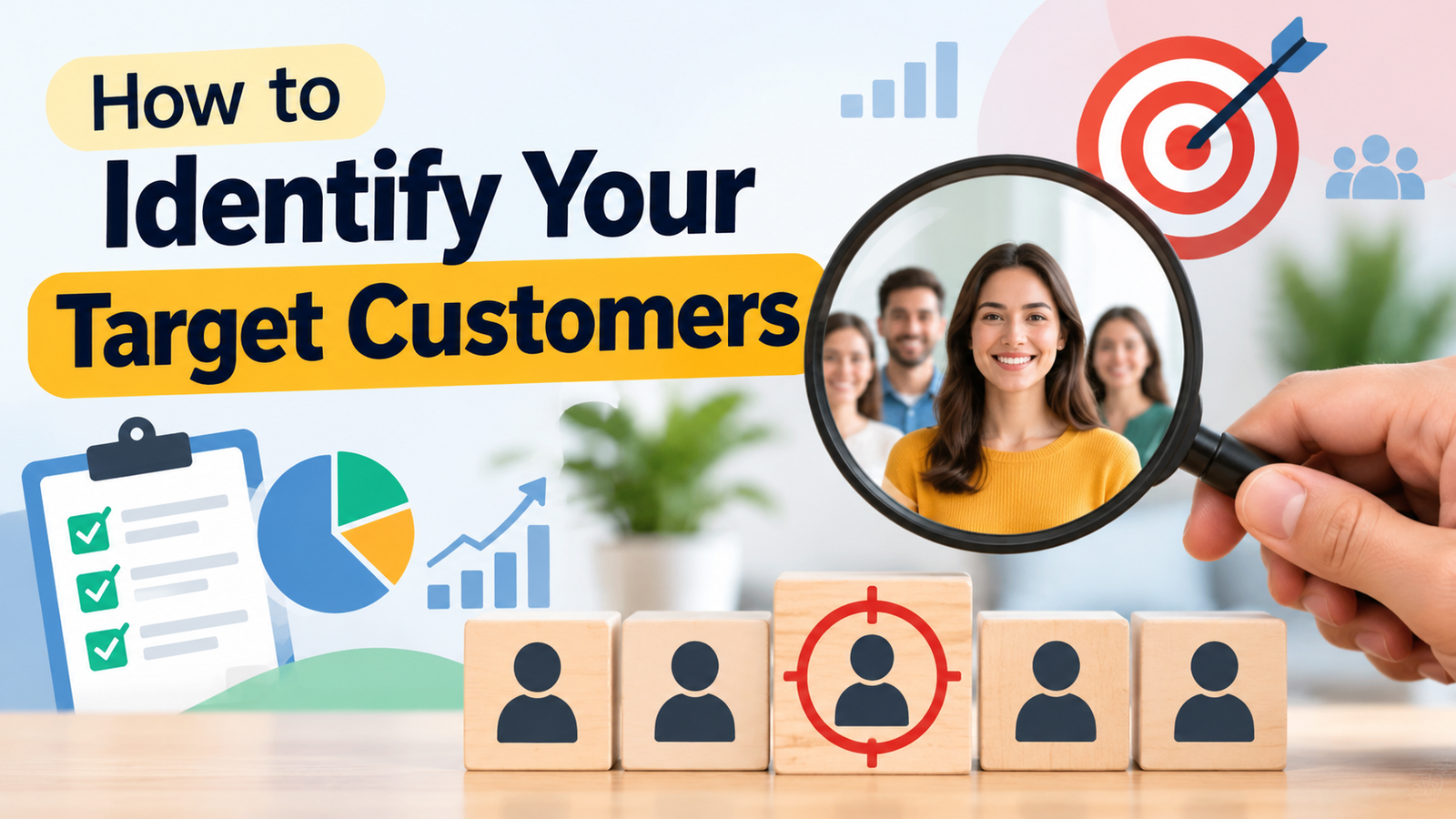
Understanding your customers is one of the most important parts of starting and growing a small business. You may have a great product or service, but if you do not know who is most likely to buy it, your marketing can become confusing and expensive.
In my opinion, identifying your target customers helps you make better decisions about almost every part of your business. It can influence your product, pricing, advertising, communication, and even the location where you operate.
A target customer is simply the type of person or business that is most likely to need and purchase what you offer.
What Is a Target Customer?
A target customer is a specific group of people or organizations that a business wants to reach with its products or services.
For example, a business selling school supplies may target students and parents. A company offering accounting services may target small business owners. A local fitness service may focus on people living in a particular area.
Your target customer does not have to include everyone.
Trying to sell to everyone can make your marketing message too general. A clearer target audience can help you communicate your value more effectively.
Start With Your Product or Service
The first step is to understand what you are selling.
Ask yourself what problem your product or service solves.
Does it save time?
Does it make something easier?
Does it provide convenience?
Does it help customers save money?
Does it offer better quality?
Once you understand the main benefit, think about who would care most about that benefit.
For example, a time saving service may be particularly attractive to busy professionals or parents.
Look at Customer Needs
Customers usually buy because they have a need or want.
Understanding those needs can help you identify your audience.
Think about the problems people face that your business can solve.
You can learn about customer needs by talking to people, reading online reviews, checking questions on forums, studying competitors, and observing buying behavior.
Customer complaints can be particularly useful because they show areas where existing products or services may not be meeting expectations.
Consider Age and Life Stage
Age can sometimes help you understand your audience, but it should not be the only factor.
Different age groups can have different needs, budgets, and preferences.
Students may have limited budgets and prefer convenience. Parents may prioritize reliability and value. Professionals may be more interested in saving time.
Life stage can sometimes be more useful than age alone.
Think about whether your product is designed for students, new parents, homeowners, retirees, business owners, or another group.
Consider Location
Location can be very important for local businesses.
A restaurant, repair service, cleaning company, or local shop needs to understand where potential customers live or work.
Think about the area you can realistically serve.
If you offer delivery, consider how far you can deliver while keeping costs reasonable.
For online businesses, location may be less important, but shipping availability, language, time zones, and local preferences can still matter.
Consider Customer Budget
Price is an important part of customer behavior.
Think about how much your target customers are realistically willing and able to spend.
This does not mean you should automatically choose the cheapest price.
Instead, understand whether your product belongs in a budget, mid range, or premium category.
Your pricing should match both customer expectations and the value you provide.
Study Your Competitors
Competitor research can help you understand the market.
Look at who is already buying from similar businesses.
Read customer reviews and comments.
Notice what customers like and what they complain about.
You may discover that competitors are serving a broad market while ignoring a smaller group of customers.
That group could become your target audience.
Talk to Potential Customers
One of the simplest ways to understand customers is to talk to them.
Ask potential customers about their problems, preferences, budgets, and experiences with existing products.
You do not need a formal research company.
You can have conversations with people who match your potential audience or conduct a simple survey.
The goal is to learn rather than convince people to buy.
Listen carefully to what they say.
Create a Customer Profile
After collecting information, create a simple customer profile.
Give the profile a general description.
For example, you might identify your typical customer as a working professional who wants convenient services and has limited free time.
You can include information such as age group, location, occupation, interests, common problems, budget, and buying preferences.
This profile is not supposed to describe every customer. It is a tool to help you understand the people you are trying to reach.
Look at Existing Customers
If your business has already started, your existing customers can provide valuable information.
Look for patterns.
Which products sell the most?
Which customers return?
Where do your customers come from?
What questions do they ask?
Which marketing channels bring the most inquiries?
This information can help you identify the people who are already interested in your business.
Use Online Research
The internet can provide a large amount of customer information.
Search for questions related to your product or service.
Read reviews on competitor websites and marketplaces.
Look at discussions on social media.
Study commonly searched questions and topics related to your industry.
The goal is to understand how people describe their problems.
Using the same language customers use can also make your website and marketing easier to understand.
Do Not Make Too Many Assumptions
It is easy to assume you know what customers want.
However, assumptions can sometimes be wrong.
You may think customers care most about price when they actually care more about convenience.
You may believe people want many product options when they actually prefer a simple selection.
This is why customer research is important.
Use real conversations, feedback, sales data, and market research whenever possible.
Start Narrow and Expand Later
A new business does not have to target a huge audience immediately.
Starting with a specific group can make marketing easier.
Once you understand that group and build a strong customer base, you can expand into related markets.
For example, a business might first focus on one type of customer and later introduce products for another related audience.
Starting narrow can give you a clearer direction.
Keep Learning About Customers
Customer research is not something you do only before launching.
People change.
New competitors appear. Trends develop. Budgets change. Technology influences buying habits.
Keep listening to your customers.
Review feedback regularly and look for new patterns.
The more you understand your audience, the easier it becomes to improve your business.
Final Thoughts
Identifying your target customers is an important step in building a successful small business.
Start by understanding your product or service and the problem it solves. Then research potential customers based on their needs, location, budget, interests, and buying behavior.
Talk to real people, study competitors, read reviews, and pay attention to your existing customers.
In my opinion, the goal is not to find the biggest possible audience. The goal is to find the people who genuinely need what you offer.
When you understand those customers, you can create better products, clearer marketing messages, and a stronger overall business strategy.